
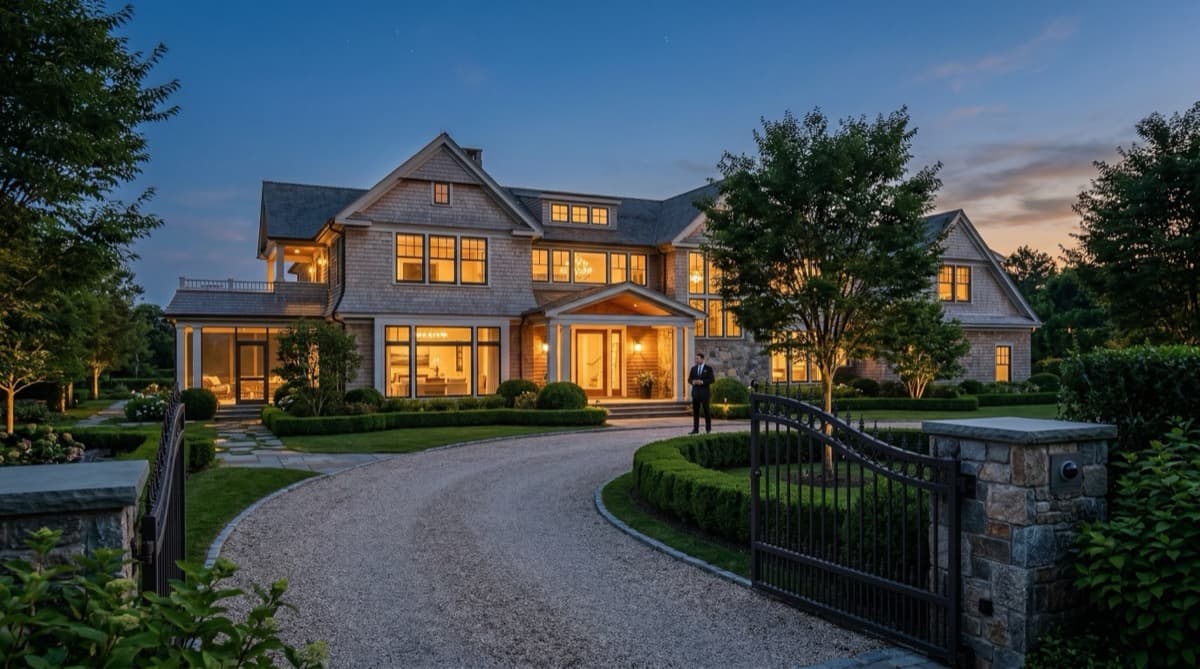
A high-value property requires a different kind of security than what most homeowners are used to thinking about. The alarm system and camera package that works for a typical suburban house does not address the risk profile of a waterfront estate, a multi-acre compound, or a residence that regularly hosts UHNW individuals and public figures. The gap between consumer home security and professional luxury home security is significant, and most property owners do not realize it exists until something goes wrong.
What is Residential Security?
Residential security is the practice of protecting a private residence, its occupants, and its assets through a combination of physical security measures, trained personnel, technology, and operational planning. For standard homes, this might mean a security system with door sensors and a monitoring service. For high-value properties, it means something considerably more involved.
A professional residential security program treats the property as a complete operating environment. It accounts for the physical layout, the surrounding area, the daily patterns of the people who live and work there, the seasonal changes that affect risk, and the specific threat profile of the homeowner. It is not a product you install. It is a discipline you maintain.
Why Standard Home Security is Not Enough for High-Value Properties
Consumer security systems are designed for deterrence and notification. A camera records. An alarm sounds. A monitoring center calls. These tools have value, but they are reactive by design. They tell you something has already happened.
For properties valued at $10 million or more, or for homeowners whose profile creates elevated risk, the question is not whether someone can break in after the alarm triggers. The question is how to prevent unauthorized access entirely, detect threats before they reach the property line, and respond with trained personnel if something does develop.
Scale. A 15,000-square-foot estate on four acres with a pool house, guest cottage, and waterfront access has exponentially more entry points and blind spots than a standard home. Camera coverage alone does not solve this.
Staffing. An alarm system does not assess whether the person at the gate is a legitimate contractor or someone who found the renovation company's name on a permit filing. Trained security personnel observe, assess, and act. Technology supports them. It does not replace them.
Threat profile. A standard home faces opportunistic property crime. A high-value property may face targeted surveillance, social engineering, insider threats from household staff, or risks tied to the homeowner's public profile. These require professional security services and threat assessment capabilities that a consumer alarm company is not equipped to provide.
What Does a Professional Residential Security Program Include?
The scope depends on the property and the client, but certain elements are consistent across serious implementations.
Security Audit and Risk Assessment
Everything begins with a security audit. A qualified security company will conduct a physical assessment of the property, evaluate existing security systems, identify vulnerabilities, and produce a written report with prioritized recommendations. This is not a sales pitch for equipment. It is an honest evaluation of where the property stands and what needs to change.
The audit should also include a threat assessment specific to the homeowner. Public profile, business interests, family composition, travel patterns, and any history of threats or incidents all factor into the analysis.
Security Guard Details and 24/7 Coverage
For properties that warrant it, a manned security presence is the foundation of the program. This can range from a single guard at a gatehouse to a full detail with roving patrols, fixed posts, and a dedicated command position.
The question homeowners ask most often is whether they need 24/7 security or can rely on part-time coverage during high-risk periods. The answer depends on the threat assessment. A property occupied year-round by a high-profile family almost always benefits from around-the-clock staffing. A seasonal residence may need full coverage during occupancy and reduced monitoring when vacant, with protocols for periodic checks and rapid deployment if an alarm triggers.
The quality of the security guard matters as much as the hours of coverage. Professional residential security personnel conduct regular patrols, maintain communication with the property manager and household staff, log all activity, and know how to handle situations that range from a lost delivery driver to a credible intrusion.
Perimeter Security
Perimeter security is the outer layer of the program. It includes physical barriers such as fencing, walls, and gates, as well as technology like motion-activated cameras, ground sensors, and thermal imaging. The goal is to detect and deter unauthorized access before it reaches the residence itself.
For waterfront estates, perimeter security extends to the water side of the property. This is a detail that many security providers overlook entirely. A home with 200 feet of bay frontage has 200 feet of uncontrolled access if the security plan only addresses the road-facing boundary.
Access Control
Access control governs who enters the property and how. At the basic level, this means a gated entry with intercom and camera. At a higher level, it includes credentialed entry systems, visitor management protocols, vehicle screening, and separate access procedures for household staff, contractors, and deliveries.
Contractor access is a persistent challenge, especially during renovations. A major project can bring dozens of tradespeople onto the property daily for months. Each one is a person the homeowner has never met, walking through a space that contains valuables, personal information, and access to the home's interior. Professional estate security includes a process for vetting, credentialing, and managing contractor access throughout the project.
Integrated Security Systems
Cameras, alarms, intercoms, lighting, and monitoring platforms should function as a single integrated security system, not a collection of disconnected products. A motion alert on the north perimeter should automatically bring up the corresponding camera feed at the command post. Remote monitoring adds another layer for unoccupied periods or overnight hours, with trained operators who can dispatch on-site personnel or local law enforcement as needed.
Estate Security in the Hamptons: Unique Considerations
The Hamptons present a specific set of challenges for residential and estate security that do not exist in most other luxury markets.
Seasonal Population Swings
The East End's population can increase tenfold between Memorial Day and Labor Day. Properties that sit quiet for nine months suddenly operate in a high-traffic environment with unfamiliar vehicles, increased foot traffic, and a concentration of high-profile residents that draws media and public attention. Security posture needs to adjust accordingly. What works in February does not work in July.
Waterfront and Beach Access
Many Hamptons estates border beaches with public access rights. In some areas, the public has a legal right to traverse the wet sand along the waterfront, which means foot traffic within yards of the property. During summer weekends, beachgoers regularly wander onto private property, whether by confusion or intention. The security plan must account for this without creating confrontations that generate complaints or media attention.
Contractor and Renovation Activity
The Hamptons construction market is one of the most active in the country. Properties routinely undergo multi-year, multi-million-dollar projects. During active construction, physical security is inherently compromised. Walls are open. Gates are propped. Crews arrive early and leave late. A property security program without a construction-phase protocol has a gap that lasts months or years.
Limited Road Infrastructure
Route 27 is the primary artery, and it is a two-lane road that gridlocks during peak season. Emergency response times can be affected. Evacuation options are limited. These are operational factors that any Hamptons security provider needs to account for in their planning.
Local Law Enforcement Relationships
The Southampton Town Police, East Hampton Town Police, and village departments are experienced with private security operations. They expect the private security company to be licensed, professional, and communicative. A firm without established relationships on the East End will spend the season learning what a firm with local presence already knows.
How to Choose a Residential Security Provider
Selecting a private security provider for a high-value property is a decision that should be based on capability, not price.
Look at the team. Who will actually be on your property? What are their backgrounds? Military, law enforcement, and intelligence community experience at the senior level is a reasonable expectation. Ask about the entire roster, not just the leadership.
Evaluate local knowledge. A New York security company that operates primarily in Manhattan may not understand the operational environment of a Hamptons estate. Ask about specific experience on the East End, relationships with local agencies, and familiarity with the challenges of waterfront and seasonal properties.
Request a security audit before committing. A provider worth hiring will assess your property and present a tailored plan. If the proposal is a rate card with no operational detail, that tells you what you need to know.
Ask about licensing and insurance. New York State has specific requirements for security guard companies and individual security personnel. Verify that the firm and its guards hold current licenses. Confirm liability coverage in writing.
Understand the escalation process. What happens when a guard encounters something beyond a routine situation? What is the chain of command? How does the firm coordinate with law enforcement? The answers should be specific and documented.
Roman Sanford's Approach to Residential Security
Roman Sanford has provided estate protection and residential security services across the Hamptons and greater New York area since 2015. The firm's team is drawn from Special Forces, SWAT, the intelligence community, and senior law enforcement, and it maintains year-round operations and relationships on the East End.
Every residential security engagement begins with an on-site assessment and a written security plan tailored to the property and the client's risk profile. The firm provides armed and unarmed security personnel, integrated technology solutions, and ongoing program management for properties that require continuous coverage.
To discuss residential security for your property, contact our team for a confidential consultation.